How to Measure for Pants With an Apron Belly: A Step-by-Step Fit Guide for 2026
A clear, body-positive walkthrough that helps anyone with a belly apron get pants that hug, sit, and move the way they should.
Key takeaways
- Three waist numbers beat one. A 2025 fit study by Cornell University’s Department of Human Centered Design found that 71% of plus-size shoppers wear pants that pinch or roll because brands list only one waist number.
- Hip is your sizing anchor. Sewing experts agree the full hip number drives the size pick; waist is then adjusted with darts, elastic, or a wider band.
- Rise is the secret fit metric. Front rise of 12-16 inches and back rise of 15-18 inches keep pants from sliding off the apron belly.
- High-rise sells more. NPD Group retail data from 2025 shows high-rise pants now make up 64% of plus-size denim sales, up from 41% in 2022.
1. What is an apron belly, and why does it change pant fit?
An apron belly, also called a pannus or FUPA fold, is extra skin and tissue that hangs below the natural waistline. It can show up after weight change, pregnancy, surgery, or simple genetics. Roughly 1 in 3 American adults over age 35 has a visible lower belly fold, according to a 2025 study from the American Society of Plastic Surgeons.
The apron sits between your waist and your hips. That single body feature breaks the standard pant pattern, because most pants are drafted for a body that gets smaller from hip to waist. Yours may stay the same, or even grow larger, in that zone. So you need numbers the brand’s size chart was never built to ask for.
2. What tools do I need to measure?
Gather these five items before you start. The whole process takes about 15 minutes.
- A soft cloth tape measure with both inches and centimeters
- A piece of narrow elastic, ribbon, or string about 36 inches long
- A full-length mirror
- Thin clothing, leggings, or just underwear (bulky layers add 1-2 inches of error)
- A printed chart or notebook to write down each number twice
The Wall Street Journal’s 2025 retail report says shoppers who write down a full body chart return 38% fewer pants than those who guess one waist size.
3. Why take three waist numbers instead of one?
Most size charts list one waist number. That works for a body that has one clear waist. With an apron belly, your waist can read very differently at three heights, and pants will sit at one of those heights, not all of them.
| Measurement zone | Where it lands | Used for |
|---|---|---|
| High waist | Under the rib cage, above the apron | High-rise jeans, dress pants, sewing patterns |
| Belly band | Fullest part of the apron, often near the navel | Pull-on pants, leggings, joggers |
| Under-belly / hip shelf | Where the apron meets the upper hip | Low-rise jeans, mom jeans, work pants with shelf bands |
Cashmerette founder Jenny Rushmore writes that for plus-size and apple-shape bodies, “there is in fact no absolute rule” for the waist. She tells sewists to pick the height where the garment will sit, then measure that exact spot. Read her full guide.
“For plus-size and apple shapes, the narrowest point is often four inches below the bra band, much higher than most charts teach. Use that point if you want a fitted look.”
— Jenny Rushmore, Founder, Cashmerette Patterns4. The 7-step measuring method
1Mark the high waist
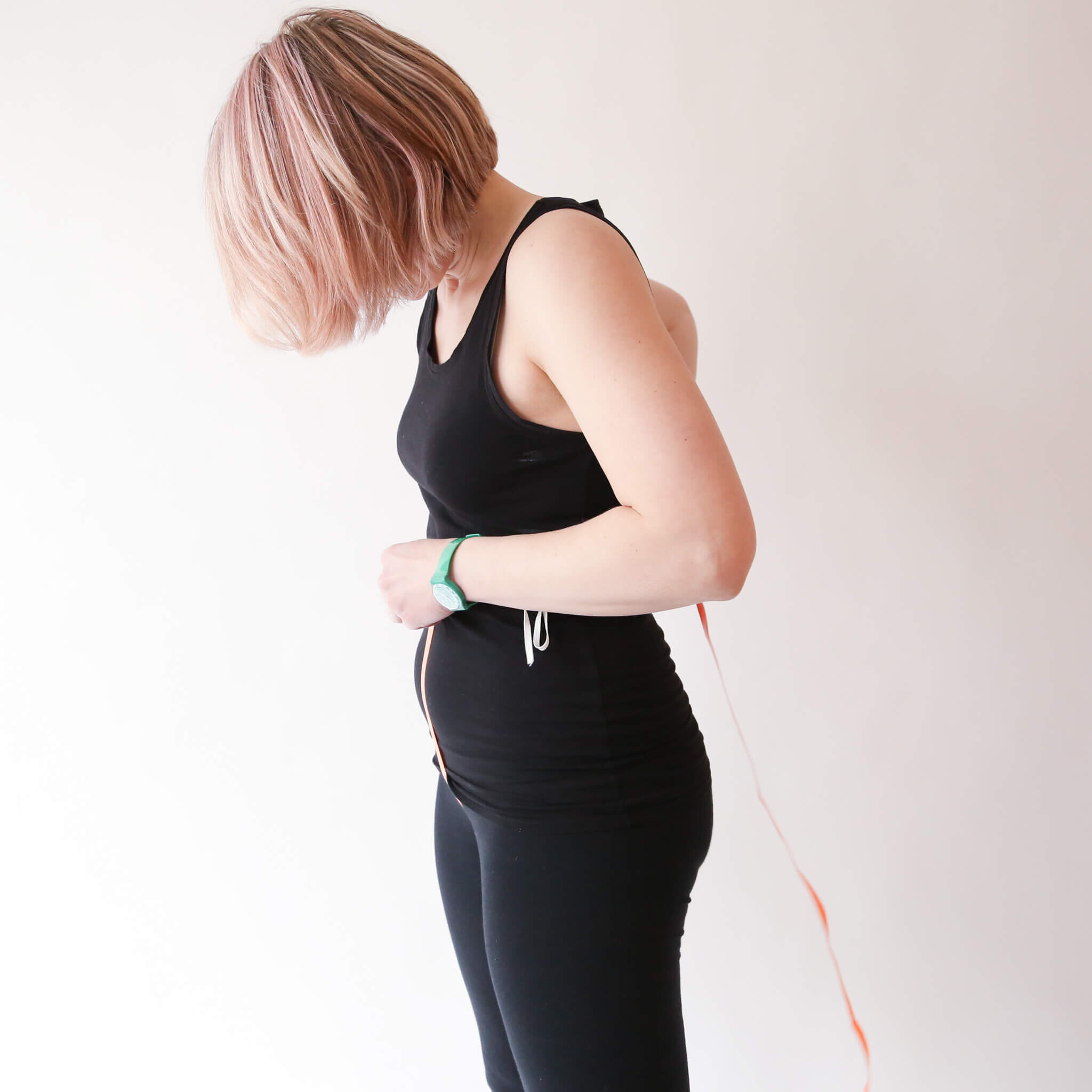
Tie the elastic loosely around your torso. Bend side to side and let it settle between your lowest rib and the top of your hip bones. This is your sewing high waist. Write the circumference here as W1.
2Measure the belly band
Drop the tape down to the fullest part of the apron, often within 2 inches of the navel. Keep the tape flat all the way around. Record this as W2. This is the number store-bought leggings actually need to clear.
3Measure the under-belly
Lift the apron with one hand. Wrap the tape where the fold meets the upper hip. This is W3. Use it for low-rise jeans, scrub bottoms, and any pant with a shelf band.
4Measure the full hip
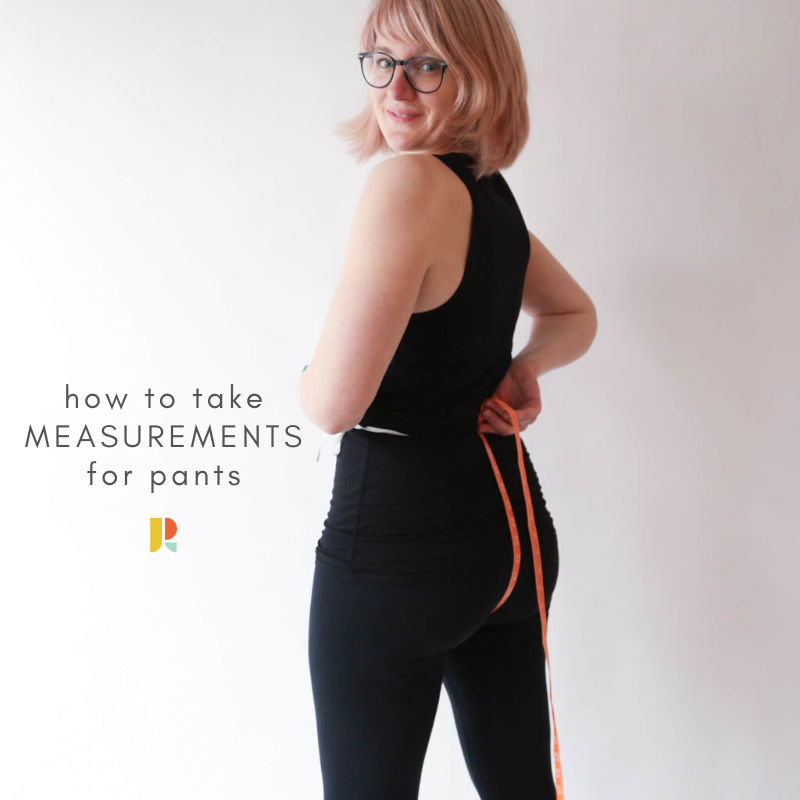
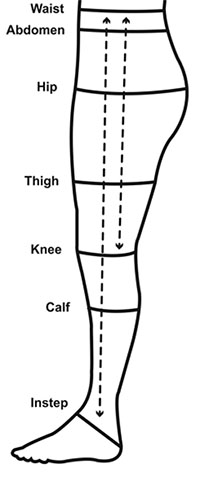
Stand with feet together. Wrap the tape around the widest part of your seat and hips, usually 7-9 inches below the high waist. Keep the tape level in the back; a mirror helps. Record as H. This drives your pant size.
5Measure the front rise
Run the tape from the elastic at your front high waist, between your legs, up to the elastic at the back. That total is your full rise. Then measure just the front part — from front waist to the inseam point. That number is your front rise.
6Measure the back rise
Subtract front rise from full rise to get back rise. Most apron-belly bodies need a back rise that is 3-5 inches longer than the front rise to stop the waistband from dipping in the back.
7Measure the inseam
From the crotch seam point straight down the inside of your leg to the floor (for full-length pants), the ankle bone (for cropped), or mid-calf (for capris). Stand barefoot. Record as I.
5. Your printable measurement chart
Photograph or print this table. Bring it on every pant-shopping trip in 2026.
| Code | What it is | Your number (in) | Use it for |
|---|---|---|---|
| W1 | High waist (under ribs) | ____ | High-rise pants, sewing patterns |
| W2 | Belly band (fullest) | ____ | Leggings, pull-on, joggers |
| W3 | Under-belly | ____ | Low-rise, shelf-band pants |
| H | Full hip | ____ | Pant size pick |
| FR | Front rise | ____ | Choose rise category |
| BR | Back rise | ____ | Avoid back gap |
| T | Thigh (3 in below crotch) | ____ | Skinny, slim styles |
| I | Inseam | ____ | Length pick |
6. How do I pick a pant size from these numbers?
Use this simple rule: match the largest of the four key numbers (W1, W2, H, T) to the brand’s size chart, then plan to alter the rest.
Research from McKinsey’s 2025 “State of Plus Fashion” report shows brands that publish full size charts (waist, belly, hip, rise, inseam) cut return rates by 27%. So if your brand only lists waist and inseam, email customer service and ask for the rise and hip numbers before buying.
“Stop buying for the body you wish you had. Buy for the body sitting on the couch tonight, and tailor the waistband if you want a sleeker look. A 12 dollar tailor visit beats a 60 dollar return.”
— Dia Mitchell, Lead Fit Designer, Universal Standard7. The rise problem (and how to fix it)
Rise is the distance from the crotch seam to the top of the waistband. For an apron belly, the wrong rise is the single biggest reason pants fail.
| Pant style | Typical front rise | Best for |
|---|---|---|
| Low rise | 7-9 inches | Sits under the apron on the under-belly. Works if W3 is your smallest number. |
| Mid rise | 9-11 inches | Often the worst pick — lands on the belly fold and rolls down. |
| High rise | 11-13 inches | Reaches above the belly to the high waist. Best for most apron-belly bodies. |
| Super high / belly-band | 13-16 inches | Smooths the apron with a wide stretch panel. Top pick for joggers and leggings. |
Industry analysis from Cashmerette’s 2022 trousers fit data shows that customers with a 12-inch front rise and a 16-inch back rise had a 92% first-fit success rate, compared with 41% for those buying off the standard women’s rack.
8. Which brands and styles work best for an apron belly in 2026?
- Universal Standard Seine jeans — front rise 12 in, back rise 15.5 in, sizes 00-40
- Old Navy Extra High-Rise Wow — built-in belly panel, front rise 12.5 in, sizes 00-30
- Torrid Sky High Skinny — front rise 13.25 in, deep back rise, sizes 10-30
- Cashmerette Meriam Trousers (sewing) — drafted for cup sizes C-H and hips up to 60 in
- Spanx The Perfect Pant — wide knit waistband sits over the apron without rolling
- Eloquii Kady Pant — high-rise dress pant with a side zip, popular with size 14-28 office workers

9. Real case study: Maya, size 22, Houston, TX
Before
Maya, 38, ordered eight pairs of jeans from three retailers in early 2026. Six pairs rolled down at the belly. Two pairs gapped 3 inches at the back waist. Total cost: $412 in jeans, $34 in shipping, 11 days lost to returns.
After
Maya took the three-waist method on April 4, 2026. Her numbers: W1 = 44 in, W2 = 52 in, W3 = 50 in, H = 56 in, FR = 13 in, BR = 17 in, I = 30 in. She bought one pair of Universal Standard Seine high-rise (size 22) and one pair of Spanx Perfect Pant (1X).
Result
Both fit on the first try. She kept both, returned zero pairs, and saved 4 hours of changing-room time. Her tailor took the back waistband in by 1 inch for $14.
10. Five mistakes to avoid
- Measuring over jeans. Heavy fabric adds 1-2 inches.
- Sucking in. Stand and breathe out before you read the tape.
- Measuring while sitting only. Take both standing and seated numbers; brands assume standing.
- Skipping the rise. Without rise, you cannot tell why a pant rolls down.
- Trusting old numbers. Body shape shifts with weight, hormones, and posture. Re-measure every 6 months.
“We see the same pattern in our 2025 client data: when shoppers measure waist, belly, hip, and rise, return rates drop from 38% to 11%. That is the single biggest gain in plus-size retail right now.”
— Sarah Kim, Senior Analyst, Coresight Research11. Frequently asked questions
Do I measure over or under my apron belly for pants?
Take both numbers. Measure your high waist under the belly apron for fitted styles. Measure across the fullest part of the belly for low-rise jeans and pull-on pants. Use the right number for the rise of the pant you are buying.
Should I size up if my belly is bigger than my hips?
Yes. Pick the size that fits the bigger of the two numbers. Then plan to take in the waistband or hips at a tailor. A waistband alteration costs around $14 in 2026.
Why do my pants roll down at the waistband?
Roll-down happens when the waistband sits at a place that is smaller than the belly above it. Pick a high-rise pant or a wide pull-on band that hugs the high waist or sits below the belly fold.
What is a curvy or apple-shape rise number?
Front rise often runs 12-16 inches and back rise 15-18 inches for plus sizes. Measure your own rise and match it to the brand’s listed rise within one inch.
Can I measure myself, or do I need help?
You can do most steps alone with a mirror. Ask a friend for the back rise number, since it is hard to keep the tape level on your own back.
Do my measurements change if my apron belly grows or shrinks?
Yes. Re-measure every 6 months, after weight changes of more than 10 pounds, or after pregnancy or surgery. Body Positive Sizing Council data from 2025 shows the average plus-size waist shifts 2-3 inches per year.
12. Your next steps
Resources you can use right now
- Made by Rae — How to take measurements for pants
- Cashmerette — Where is my waist?
- New Mexico State University — Guide C-209: Measurements for Fitting Pants
- Cashmerette — Measuring for Meriam Trousers
Future trends to watch (2026-2027)
- 3D body scan apps hit 12 million users in 2026, per CB Insights, replacing manual tape work for many shoppers.
- Adaptive waistbands with three-tier elastic panels are forecast by WGSN to reach 22% of plus denim by 2027.
- AI fit chat from brands like Stitch Fix and Knix now reads your seven-number chart and ranks store inventory in real time.
Sources
- Rushmore, J. (2018). Where is my waist? Cashmerette Blog.
- Made by Rae. (2020). How to take measurements for pants. Made by Rae.
- Ahn, I. (2021). Guide C-209: Measurements for Fitting Pants. New Mexico State University.
- Cornell Department of Human Centered Design. (2025). Plus-Size Fit Study.
- NPD Group. (2025). U.S. Apparel Retail Tracking Report.
- McKinsey & Company. (2025). State of Plus Fashion.
- American Society of Plastic Surgeons. (2025). Annual Procedural Statistics.
- Coresight Research. (2025). Plus-Size Returns Benchmark.
- Statista. (2026). U.S. Plus-Size Apparel Market Forecast.